
Pool Heater Installation in Cave Creek, AZ
Sized by the numbers, fitted to code, and explained before you spend. Call (480) 800-0993.

Schedule Service!
Professional Pool Heater Installation in Cave Creek, AZ
An Undersized Heater Never Gets the Pool Warm
An undersized heater never gets the pool warm. An oversized one costs more to buy than it needed to. Both problems trace back to a decision made before anyone picks up a tool.
Pool heater installation in Cave Creek, AZ starts with a BTU calculation. That calculation runs off your pool volume and the temperature rise you want, plus one local factor most installers skip entirely.
We install gas, propane, heat pump and solar systems across Cave Creek, Carefree, Desert Hills and north Maricopa County, alongside the rest of our pool equipment installation work.
If the heater you have can still be saved, we will tell you. That is pool heater repair, and it is usually the cheaper answer.
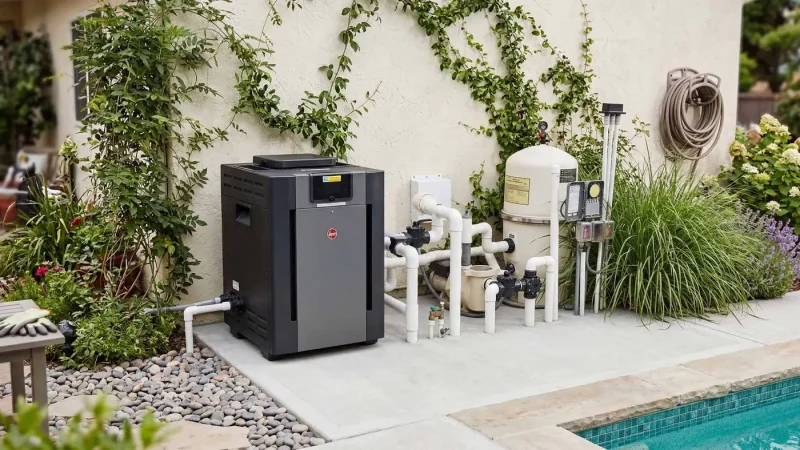
Need a new pool heater? Ask Bahama Blue Pool & Spa for a free quote
Pool Heater Equipment We Install




Why Install a Pool Heater in Cave Creek, AZ?
Because the water gets cold months before the air does.
Cave Creek mornings drop hard once October arrives, and an unheated pool follows them down. By November most pools here sit somewhere in the sixties, which is swimmable for about nobody. A heater is the difference between a three month season and a nine month one.
Spas are the other half of it. A spa without a heater is a decorative pond. Heating one is also a much smaller job, because there is so much less water in it.
We install heaters on in-ground pools, spas and hot tubs, combined pool and spa systems, custom pools, and rental or vacation properties across Maricopa County.
What Size Pool Heater Do You Need?
The BTU Calculation
The arithmetic is simple enough to do yourself.
BTUs = gallons x 8.33 x degrees of temperature rise
A 20,000 gallon pool you want to lift 10 degrees needs 20,000 x 8.33 x 10, which is about 1.67 million BTUs of energy.
Divide that by the heat-up time you want and you get the heater output you need. Divide it by a given model’s capacity instead and you get how long that model will take.
The Cave Creek Altitude Correction
Here is the part that gets missed.
Heater output requirements rise 4% for every 1,000 feet above sea level. Cave Creek sits at roughly 2,553 feet. A heater here needs about 10% more output than the same unit doing the same job at sea level.
Size off a generic online calculator and you are already 10% short before the unit arrives. That gap shows up as a heater that runs constantly and never quite gets there. It is the most common heater complaint we hear.
Pool or Spa Changes the Answer
The two are sized on different principles.
For a pool, the controlling factor is heat loss through the water surface, so surface area drives the calculation. For a spa, it is how fast you want it hot, so water volume drives it.
Put another way: maintenance heating is a surface area problem, and intermittent heating is a volume problem. A combined pool and spa system has to satisfy both.
Wind exposure and shade change the numbers too, and we look at those on site.
Pool Heater Types We Install
Gas and Propane Heaters
The fastest at raising temperature, which is why they dominate here. You can heat a spa in under an hour and bring a pool up for a weekend without planning days ahead.
They cost more to run per hour of heating, so they suit people who heat on demand instead of holding a temperature all season.
Natural gas wants a supply line carrying adequate pressure. Propane wants a tank and the right regulator. We also convert between the two, which is a heater change more often than people expect.
Heat Pumps
These move heat out of the air instead of making it, which makes them far cheaper to run than gas.
The catch is speed and air temperature. A heat pump warms slowly, and the colder the air, the less heat it can extract. On a January morning in Cave Creek it will deliver noticeably less than it does in September.
They suit people holding a steady temperature across a long season instead of heating from cold for a weekend.
Solar Heating
The lowest running cost of the three, because the fuel is free. Arizona sun makes solar genuinely viable here in a way it is not in most of the country.
It needs roof or ground area for the collectors, and it heats only when the sun is on them. Most solar installations pair with a gas heater for the days that need it.
What Pool Heater Installation Costs
Cost splits into the unit and the installation, and they move independently.
The unit is driven by type and output. Gas heaters and heat pumps sit in different brackets, and a larger BTU rating costs more within either.
Installation depends on what your equipment pad already has. A like-for-like gas heater swap onto an existing gas line is the straightforward case. Running a new gas line, upgrading the meter, adding a dedicated electrical circuit for a heat pump, or building a compliant base all add real cost.
Three things change the number more than people expect:
- Whether a gas supply line already exists at the pad and carries enough pressure
- Whether the electrical supply can take a heat pump without a new circuit
- Whether the pad has space that meets the required clearances
We quote the unit and the installation separately, so you can see which is which. Permits are part of that quote. A pool heater installation in Cave Creek has to meet local code, and we handle that paperwork ourselves.
Pool Heater Brands We Install
Our pool heater installation work covers the manufacturers found on Cave Creek equipment pads.
- Pentair: MasterTemp, UltraTemp, ETi
- Hayward: Universal H-Series, HeatPro
- Jandy and Zodiac: JXi, LXi
- Raypak: AVIA, Professional Series
- Rheem, AquaCal and EcoSmart
Every unit we install carries a manufacturer-backed warranty, and we fit each one to warranty-compliant standards so that warranty actually holds if you ever need it.
Staying with the brand already on your pad keeps the plumbing simpler and the parts easier to source later. It also helps if your pool automation is from the same family, because a Pentair, Hayward or Jandy heater talks to a controller of its own make without any translation.
Pool Heater Installation Requirements That Catch People Out
Pool heater installation in Cave Creek is governed by real standards, and the rules are not obvious.
Clearances come from ANSI Z223.1, and they depend on the external temperatures a given unit reaches. That means they vary between manufacturers, so there is no single answer covering every heater.
Distance from a spa is fixed, though. Every heater sits at least five feet from the inside wall of a spa, unless a fence, wall or other permanent barrier separates the two.
The base matters as well. Heaters need a level, non-combustible surface such as brick or concrete. Where hollow concrete block goes under one, the cells all face the same direction with the end left open. The pad stands at least four inches high, capped with sheet metal.
Then there is the fireman switch, the circuit that shuts the heater down when the pump stops. It keeps the heater from firing with no water moving through it. On a millivolt heater the wire run between heater and timer cannot exceed 30 feet. Past that, resistance drops the millivolts too low for the gas valve to work reliably.
That last one causes intermittent faults that look exactly like a failing heater, and it traces back to how the thing was wired on day one.
Repair or Replace Your Pool Heater?
Replace when the heat exchanger has corroded through, or when parts for the model have stopped being made. Replace too when the unit never had the output for the pool in the first place.
Repair when a part failed inside a sound unit. Igniters, flame sensors, thermostats, pressure switches and control boards are all replaceable, and pool heater repair is usually the cheaper route.
The signs that point to a new heater:
- The unit is over 8 to 10 years old
- Heating times are much slower than they used to be
- The heater will not stay lit or keeps shutting itself off
- It is leaking, or there is internal corrosion
- You are upgrading to a variable-speed pump or adding automation
- You are converting from propane to natural gas, or the other way
We will inspect your existing system at no charge as part of any installation quote, so you find out which of the two you are looking at before you commit to anything.
One point in favor of replacing: a heater that was never sized correctly for Cave Creek altitude will keep disappointing you no matter how many parts go into it.
Cutting Pool Heater Running Costs in Cave Creek
The biggest lever is not the heater. It is what you do about evaporation.
An unblanketed pool can lose as much as 50% of its total temperature rise. A blanketed pool cuts that to somewhere between 15% and 25%. A cover pays for itself faster than any efficiency upgrade you can buy. The US Department of Energy reaches the same conclusion about pool heating costs generally.
After that, the things that matter are shade, wind exposure and how you use the pool. Holding a steady temperature all season is a very different energy bill from heating on demand for weekends, and it changes which heater type makes sense for you.
Hard water plays a part too. Calcium scales the heat exchanger, which cuts heat transfer and makes the unit work harder for the same output. It is the same mineral that leaves the white band on your pool tile. Keeping the water balanced is what a weekly pool service route is doing for the heater in the background.
We stay on the system after installation as well, with heater inspections, seasonal checks, filter cleaning and automation adjustments as the seasons turn.
Our Pool Heater Installation Process
1. Sizing and Site Survey
Pool volume, target temperature, heat-up time, altitude correction, wind and shade. We also check gas supply, electrical capacity, the space available on the pad, and whether the pool pump delivers the flow the heater needs.
2. Recommending the Unit
Type and output, with the running cost explained alongside the purchase price. The cheapest unit to buy is frequently not the cheapest to own.
3. Removing the Old Heater
Out with the old unit. We make the gas or electrical supply safe, then take an honest look at the plumbing while everything is open.
4. Fitting and Connecting
Base, clearances, plumbing, gas or electrical connection and the fireman switch, all fitted to manufacturer specification and the relevant standard. Permits and local code compliance are handled as part of the job.
5. Commissioning
We fire it, verify temperature rise, check ignition and cycling, and confirm the safety shutoffs work. Every pool heater installation in Cave Creek finishes this way. Then we set the controls, sync it with your automation if you run any, and show you how to work it.
Book Your Pool Heater Installation
Tell us your pool size, the temperature you want, and whether you have gas at the pad. That is enough for us to size it before we arrive. Buying a house with a pool? A pool inspection covers the heater along with everything else.
Call (480) 800-0993, email info@bahamabluepoolandspa.com, or schedule service online. Other equipment going in at the same time sits under pool equipment installation.
We cover Cave Creek, Carefree, Desert Hills, Tatum Ranch, Desert Ridge, North Phoenix and North Scottsdale. The full service area is here.
Our Service Areas
- Desert Ridge
- Tatum Ranch
- Scottsdale
- Cave Creek
- North Phoenix
Pool Heater Installation Questions
What Cave Creek homeowners ask before putting a heater in. If yours is not here, call (480) 800-0993.
Cost splits into the unit and the installation. The unit depends on type and BTU output. Installation depends on whether gas supply, electrical capacity and a compliant base already exist. We quote both separately after seeing the pad.
BTUs equal gallons times 8.33 times your desired temperature rise. Divide by the heat-up time you want to get the required output. In Cave Creek, add roughly 10% for altitude, because output requirements rise 4% per 1,000 feet.
Yes. Heater output requirements increase 4% for every 1,000 feet above sea level. Cave Creek sits around 2,553 feet, so a heater here needs about 10% more output than the same unit at sea level.
Gas heats far faster and suits heating on demand. A heat pump costs much less to run but warms slowly and delivers less in cold air. Steady season-long temperature favors a heat pump; weekend heating favors gas.
A like-for-like swap onto existing gas and electrical connections is usually a single visit. Running a new gas line, adding an electrical circuit for a heat pump, or building a compliant base extends it.
At least five feet from the inside wall of the spa, unless a fence, wall or other permanent barrier separates them. General clearance requirements follow ANSI Z223.1 and vary by manufacturer.
No. Heaters require a level, non-combustible base such as brick or concrete. Where hollow block goes under it, the cells must face the same direction, and the pad must stand at least four inches high with a sheet metal cap.
It is the circuit that shuts the heater off when the pump stops, preventing the heater firing without water flow. On millivolt heaters the wire run must stay under 30 feet, or the gas valve loses reliable operation.
Repair when a part failed in a sound unit, since igniters, sensors, thermostats and boards are all replaceable. Replace when the heat exchanger has corroded through, parts are discontinued, or the heater was undersized from the start.
Substantially. An unblanketed pool can lose up to 50% of its total temperature rise, while a blanketed pool loses only 15% to 25%. A cover is the cheapest heating improvement available.