
Salt Water Pool Systems in Cave Creek, AZ
Conversions, cell replacement and scale cleaning. Call (480) 800-0993.

Schedule Service!
Salt Water Pool System Service in Cave Creek, AZ
A salt water pool is a chlorine pool. The salt cell sits in your plumbing and makes the chlorine for you, a little at a time, so you stop hauling jugs home from the store. That is the whole trick, and almost everything people say about salt pools follows from it.
We install, convert, service and repair salt water pool systems on Cave Creek pools, alongside the rest of our pool services. Salt cell replacement, scale cleaning, flow switch and sensor faults, control board errors, chlorine to salt conversions. If your system is throwing a low salt warning and the water still looks and smells right, that is usually a reading problem, so call before you buy six bags of salt.
A Salt Pool Is Still a Chlorine Pool
The sanitizer in your water is free chlorine, same as any other pool. What changes is where it comes from and how steadily it shows up. A tab feeder dumps a slug of chlorine and then tapers off for days. A cell running four hours produces a flatter line. Flatter is what keeps algae from getting a foothold, and in a Cave Creek July that matters more than anything else on this page.
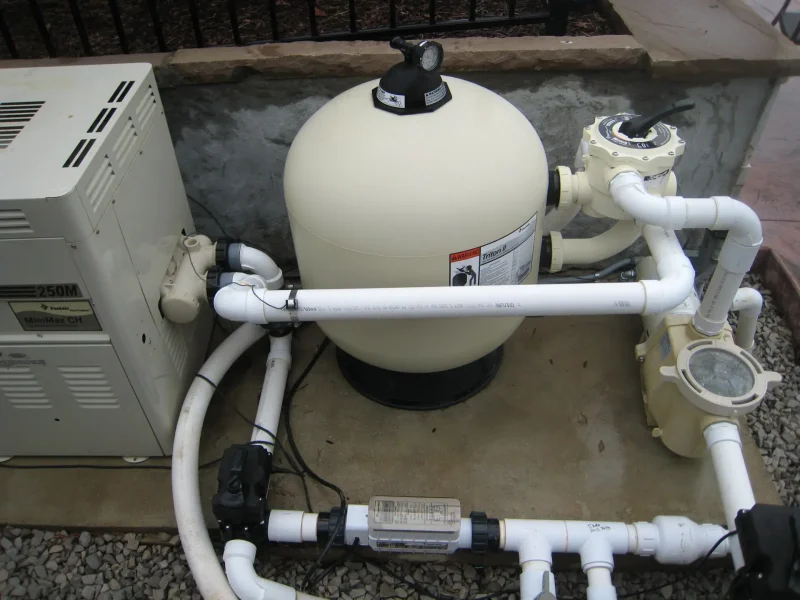
Thinking about a salt water pool conversion? Ask Bahama Blue Pool & Spa for a free quote
Salt Chlorine Generator Brands We Service




How a Salt Chlorine Generator Makes Chlorine
Dissolved salt is sodium chloride. Push pool water through a cell full of electrically charged plates and electrolysis splits it apart. You get chlorine, sodium hydroxide, and a trace of hydrogen gas.
Two things fall out of that reaction, and between them they explain most salt pool problems.
First, the chlorine does its work and then reverts to salt and water, so the same salt gets used again. You are not burning through salt the way you burn through tabs. You top it up to replace what physically leaves the pool: backwash, splash-out, kids carrying water out on towels, and the monsoon that overfills the pool and pushes it out the skimmer.
Second, the sodium hydroxide stays behind, and it is caustic. The cell manufactures a base in your own plumbing every time it runs. That is why salt pools climb in pH, and it gets its own section below.
The hydrogen is the reason your system has a flow switch. If the pump stops, the cell has to stop, because hydrogen with nowhere to vent is a genuine hazard. Anyone who tells you to jumper a dead flow switch so the cell will run again is telling you to defeat a safety interlock. Do not do it, and do not let anyone do it to your pool.
How Much Salt a Cave Creek Pool Needs
Most residential systems want somewhere around 3,000 to 3,500 ppm. Some commercial-grade units run as high as 8,000. Your manual gives the number for your cell, and it is the only number that counts.
Getting a 10,000 gallon pool up to 3,000 ppm from zero takes roughly 250 pounds of salt. That is a lot of bags, which is why conversion is a one-time expense and upkeep is not. After the initial charge you are adding a bag here and there.
Test properly before you add anything. A titration kit reads in steps of about 200 ppm per drop, and a photometer lands in the same neighborhood. Your control panel’s own salt number is convenient and it drifts. An older cell with scale on the plates reads the water as saltier or less salty than it really is, depending on what is coating what. When the panel and the test kit disagree, trust the kit.
One more thing that trips people up. Salt raises total dissolved solids, and there is no test that separates the salt part of your TDS from the part that is sunscreen, sweat and dust. A high TDS reading on a salt pool is expected and tells you almost nothing on its own. Do not let anyone talk you into a drain and refill on that number alone.
Why Salt Water Pools Push pH Up
Every hour your cell runs, it puts sodium hydroxide in the water. pH climbs. On a chlorine pool you fight pH drift now and then. On a salt pool it is a standing condition, and you plan for it.
It is the main reason salt pools go wrong when nobody is watching them. Left alone, pH drifts up, and in Cave Creek water that is already hard, high pH is the starting gun for scale. Scale lands on the cell plates first, because that is where the action is.
If you are running your own salt pool, test pH twice a week through the summer. Once a month is how salt pools end up scaled.
Salt Cell Cleaning and Scale in Cave Creek Hard Water
Cave Creek water comes out of the tap hard, and evaporation in a 110-degree week concentrates what is already there. Calcium goes up all summer whether you like it or not.
Here is the part homeowners do not expect: you cannot lower calcium hardness by adding something to the water. Nothing on the shelf takes it out, so the only way down is draining part of the pool and refilling it. So on a Cave Creek salt pool, managing scale comes down to controlling pH and cleaning the cell. No product does it for you.
Salt cell cleaning is the fix, and the reason it matters is that a cell with scale on the plates produces less chlorine while the panel still reports it is working. You get a pool that is slowly losing the fight while every gauge says fine. We inspect and clean cells on a schedule instead of waiting for the water to go cloudy, because by the time the water tells you, you have already lost a week.
Some cells are self-cleaning and reverse polarity to shed buildup. They still need eyes on them in this water. Self-cleaning slows the problem down, it does not end it.
Converting a Chlorine Pool to Salt Water
Converting is straightforward on most Cave Creek pools. We fit the cell into the return plumbing after the filter and heater, then mount the control box near the equipment pad and wire it in. After that we add the initial salt charge and set output for your pool volume and how much sun the water takes.
What we check before quoting a conversion:
- Your equipment pad layout, because the cell needs a straight run of pipe and enough clearance to come out for cleaning
- The heater order, since a heater ahead of the cell is correct and some pads are plumbed the other way
- The pool surface and any metal in the water, because older pools with exposed rebar, copper heat exchangers in poor condition, or natural stone coping need a conversation before you raise salinity
- Your pump run time, because a cell only makes chlorine while water is moving
That last one catches people. If your pump runs two hours a day, a salt system will not keep up in July no matter how you set it. It usually pairs with a pool pump installation or a schedule change.
A conversion also pairs naturally with pool automation, since the same controller that runs your pump can hold the cell’s output schedule and let you adjust it from your phone.
What a Saltwater Pool Conversion Costs
A saltwater pool conversion costs what it costs because of three things: the salt chlorine generator itself, the initial salt charge, and what your equipment pad needs before the cell can go in.
The generator is the big line, and it is priced by the pool volume it is rated for. Sizing up a step is usually money well spent in Phoenix heat, because a cell that spends the summer at part output lasts longer than one pinned wide open from May to September.
The salt charge is a one-time cost and it scales with pool size, at roughly 250 pounds per 10,000 gallons to reach 3,000 ppm.
Pad work is the variable. A clean pad with room after the heater is a simple job. A crowded pad, a panel with no spare breaker, or plumbing that needs rerouting adds labor.
We quote the equipment and the labor separately on every saltwater pool conversion, so you can see what you are paying for. Call (480) 800-0993 or email info@bahamabluepoolandspa.com and we will look at your pad before quoting anything.
Pentair IntelliChlor, Hayward TurboCell and Jandy TruClear Salt Cells
We install and service all three of the main systems on Cave Creek pools.
The Pentair IntelliChlor salt cell is the one you see most on pads built around Pentair equipment, and it talks to IntelliCenter cleanly if you already run Pentair automation. Most Cave Creek pools take the IC40.
The Hayward TurboCell salt cell runs with AquaRite and the newer S3 control boxes. It is the salt cell we replace most often on older Cave Creek pools, simply because there are a lot of them out there. You can read the current Hayward salt systems and cell sizes on their own site.
The Jandy TruClear salt cell has a smaller footprint that suits a tight pad, and it fits neatly with Jandy iAquaLink automation.
Our advice: match the cell to the automation and equipment you already have. Mixing brands works, but you lose the clean integration, and troubleshooting a mixed pad takes longer when something goes wrong. If your pad is already one brand, stay there unless there is a reason not to.
When a Salt Cell Needs Replacing
Cells wear out. The plates have a coating that is consumed over time, and once it is gone no amount of cleaning brings the output back.
How you tell a spent cell from a dirty one:
- Chlorine stays low even with output turned up and salt in range
- The panel reports the cell is producing while a test kit shows nothing to show for it
- The plates look worn or flaked when you pull the cell, with no white crust to wash off
- Cleaning brings the output back for a week or two and then it sags again
If a cell is scaled, cleaning fixes it and it is cheap. If a cell is spent, cleaning is a waste of an afternoon. Knowing which one you have got is most of what you are paying us for, and we will tell you straight when a cell has another season in it.
Pool Salt System Repairs We Handle in Cave Creek
Salt system calls usually come down to a short list of faults, and we see all of them on Cave Creek pads.
Flow switch faults, where the cell will not fire because it does not believe water is moving. Sometimes the switch is dead, sometimes the paddle is fouled, sometimes flow really has dropped because the filter needs service.
Salt reading faults, where the panel says low salt and the water is fine. Usually a scaled cell or a failed sensor.
Control board and display errors, which we diagnose against the manufacturer’s code list.
Wiring and breaker problems, which are more common than people think on pads that have been added to over the years.
Scale on the plates, which is a cleaning job, and one we would sooner catch on a routine visit than after the water turns.
If the water has already gone green while the cell was down, that is a separate job and we cover it on our green to clean page.
Salt Water Pool vs Chlorine
The case for salt is real and it is smaller than the marketing suggests it is.
What you actually get: sanitizer that arrives steadily instead of in slugs, water that feels softer on the skin, no jugs stacked in the garage, and one less errand. The water feels different because there is salt in it, roughly a tenth of what is in seawater, enough to notice and nowhere near enough to taste like the ocean.
What you do not get: a chemical-free pool. You still test the water, and you adjust pH more often than you did before. Shocking after a party or a dust storm does not go away either.
The downside list is short. Higher cost to get started. pH management becomes a standing job. Salt is hard on some natural stone coping and on untreated metal. Cells are consumable and you will buy another one eventually.
For most Cave Creek homeowners on a regularly serviced pool, salt is worth it. For someone who wants to touch the pool as little as possible and is not going to test anything, a salt system left alone goes wrong the same way any pool left alone goes wrong. It just costs more to ignore.
Our Salt System Service Process
1. Test the Water First
Salt, free chlorine, pH, alkalinity, calcium hardness and stabilizer. We test before touching the equipment, because the numbers usually say what is wrong before the panel does.
2. Inspect the Cell
We pull the cell out of the plumbing and look at the plates in daylight. Scale and wear are two different problems with two different answers, and you cannot tell them apart through the housing.
3. Check Flow and the Interlock
A cell cannot make chlorine in water that is standing still, so we check pump performance and filter condition before we blame the cell. The interlock has to work too, and we test it.
4. Read the Panel’s Codes
Error codes on these systems are specific, so we look them up against the manufacturer’s list every time. Reading them properly saves an hour of poking around.
5. Clean, Repair or Replace
We clean a scaled cell on the spot and replace whatever part has failed. If the cell is spent, we quote it and explain why we think so before we order anything.
6. Set Output and Show You the Panel
We set output for your pool volume and the season, then walk you through changing it yourself, because you will want to turn it down in November.
Book Salt Water Pool System Service in Cave Creek
You might want a chlorine pool converted to salt, or a cell that stopped producing looked at. We also fold salt systems into a regular weekly pool service. We cover Cave Creek and the surrounding service area.
Call (480) 800-0993, email info@bahamabluepoolandspa.com, or schedule service online. We will look at the pad and the water before we tell you what it needs.
Our Service Areas
- Desert Ridge
- Tatum Ranch
- Scottsdale
- Cave Creek
- North Phoenix
Salt System Questions
The questions Cave Creek homeowners ask us most about salt water pool systems, salt cell replacement and conversions.
It depends on the brand and the pool volume the cell is rated for. A Pentair IC40 and a Hayward TurboCell for the same size pool are not the same price. We quote the cell and the labor separately.
Manufacturers rate cells in hours of production, so the answer in years depends on how hard yours works. In Phoenix heat with long run times, cells work harder than the rating assumes. A cell that is cleaned regularly lasts longer.
Pull it and look. Scale is white crust on the plates and washes off. Wear shows as plates that look thin or flaked. Cleaning fixes the first and does nothing for the second.
Most systems run at 3,000 to 3,500 ppm. Reaching 3,000 ppm from zero takes about 250 pounds per 10,000 gallons. Check your manual, since some units want a different range.
The cell produces sodium hydroxide alongside chlorine, and that is a base. pH climbing is normal on a salt pool. Plan on adding acid regularly and keep an eye on alkalinity.
Usually a scaled cell or a failed salt sensor reading wrong. Test the water with a kit before adding more salt, because over-salting is harder to undo than under-salting.
Most Cave Creek pools convert without trouble. We check the pad layout, the heater order, the pump run time, and any natural stone or exposed metal before quoting.
No. A salt pool makes its own chlorine from salt. The sanitizer in the water is still free chlorine, just generated on site instead of poured in.
Less chlorine handling, yes. Less testing, no. pH needs more attention on a salt pool, and the cell needs inspecting and cleaning.
You can, with a proper cell cleaning solution and care. Most damage we see comes from acid mixed too strong or from prying at scale with a screwdriver, which ruins plates that were fine.