
Pool Filter Installation in Cave Creek, AZ
Sized to your pump, plumbed properly, started up and explained. Call (480) 800-0993.

Schedule Service!
Professional Pool Filter Installation in Cave Creek, AZ
Most Filters That Disappoint Were the Wrong Size From Day One
Pool filter installation in Cave Creek, AZ starts with arithmetic: your pump’s maximum flow rate against the filter’s rated media rate. Get that wrong and the new filter clogs quickly, cleans badly, and sends dirty water back to the pool while the gauge reads normal.
We install cartridge, sand and DE systems across Cave Creek, Carefree, Desert Hills and north Maricopa County. Each one is sized to the pool itself, not to whatever happened to be on the pad before.
If your existing filter is only dirty or broken, you may not need a new one at all. That is pool filter cleaning or pool filter repair, and we will say so.
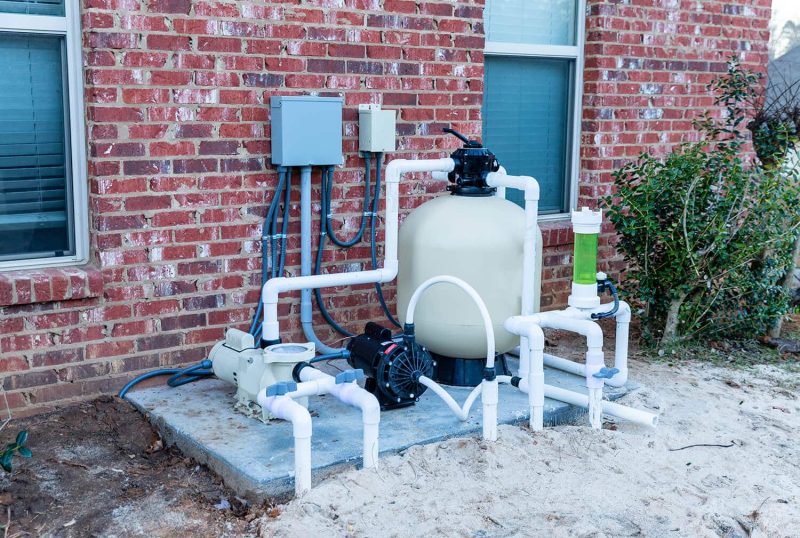
Need a new filter? Ask Bahama Blue Pool & Spa for a free quote
Pool Filter Equipment We Install




What Size Pool Filter Do You Need?
This is the question that decides whether the installation works, and it has an actual answer.
The Calculation
Filter area equals flow rate divided by filter media rate. The flow rate you use is the pump’s maximum, not its typical setting. The filter has to cope on the worst day as well as the average one.
Filter media rate is how many gallons per minute each square foot of media can handle. It comes from the standard the manufacturer certifies to, set by NSF, and it differs enormously by type:
- High-rate sand: 5 to 20 gpm per square foot
- Rapid-rate sand: 3 gpm per square foot
- Diatomaceous earth: 2.0 to 2.5 gpm per square foot
- Cartridge: 0.375 gpm per square foot
Look at the cartridge figure against high-rate sand. It is more than thirteen times lower. That is why cartridge filters need so much more surface area to do the same job, and why undersizing one is such a common mistake.
Your filter carries its area on the data label. So a pump moving 60 gpm into a cartridge filter needs roughly 160 square feet of element to stay inside the rate.
What Undersizing Actually Does
Exceeding the media rate does more than reduce performance. It changes how the filter fails, and each type fails its own way.
On a sand filter, dirt drives deeper into the bed, which makes backwashing less effective. Channels then form through the sand, water bypasses the media entirely, and the pool gets unfiltered water back.
A cartridge traps particles, minerals and oils inside and through the element, embedded so deeply that cleaning never releases them. Cartridges suffer more from high velocity than sand or DE do.
On a DE system, the powder and oils force into the grid cloth and stick there. Grid pressure climbs and grid life shortens.
In every case the symptom looks like a dirty filter, so people clean it more often and wonder why it never improves.
Pool Filter Types and Which One to Install
Cartridge Filters
The most common choice on Cave Creek pools. They filter finer than sand, use no backwash water, and take up less space on the pad. Cartridge media catches down to roughly 10 to 25 microns.
The trade is surface area and maintenance. Elements wear out as consumables, and they need proper cleaning, not a valve turn.
Not backwashing is a real advantage here, because every backwash sends hard fill water down the drain and brings more calcium in behind it.
Sand Filters
Simple, forgiving and cheap to run. The media lasts years, and cleaning is a valve position instead of a teardown.
Sand filters the coarsest of the three. It also needs the most water, because backwashing is how it cleans.
DE Filters
The finest filtration available on a pool, down to 2 to 6 microns. Water clarity from a DE system is visibly better than the other two.
They ask for more of you. You recharge the powder after every backwash, grids need periodic inspection, and the whole thing wants a teardown clean once or twice a year.
We will tell you which suits your pool, your water and how much maintenance you actually want to do. A DE system on a homeowner who wants to forget about it is a bad recommendation no matter how clear the water gets.
Does the Pool Filter Go Before or After the Pump?
After, on almost every residential pool.
Standard pool filters are pressure filters. The pump pulls water from the skimmer and main drain, pushes it through the filter, and on to the heater and returns. The filter sits on the pressure side, which is why it carries a pressure gauge.
Vacuum filters are the exception. Those sit before the pump in an open tank, and suction pulls water through the media. They turn up on some commercial installations and almost never on a home pool.
Plumbing a filter on the wrong side of the pump changes everything downstream, including whether the pool heater gets the flow it needs.
Our Pool Filter Installation Process
1. Measuring Before Recommending
We take your pool volume, your pump’s maximum flow, your turnover requirement and your plumbing layout. That determines minimum filter area before any model gets discussed.
2. Choosing the Filter
Type, size and brand, with the reasoning explained. We will oversize slightly before leaving you at the limit of the media rate. A filter running below its maximum rate lasts longer and cleans better.
3. Removing the Old System
Out with the old filter, and an honest look at the plumbing while it is open. Old copper, undersized pipe and awkward valve arrangements all show up at this point.
4. Plumbing and Fitting
New unions, correct valve positions and proper support, fitted to manufacturer specification so the warranty stands. We position the filter so you can actually open and service it, which sounds obvious and frequently is not what we find.
5. Startup and Handover
We run it, check pressure, note the clean starting pressure on the gauge, and walk you through it. That starting number tells you when to clean from then on, so you need to know it.
We also confirm the rest of the pad is happy with the change: pump, heater, salt cell, chlorinator and automation all get checked for proper flow.
Pool Filter Brands We Install
Our pool filter installation work covers the proven manufacturers found on Cave Creek pads.
- Pentair: Clean & Clear, FNS Plus, Triton
- Hayward: SwimClear, ProGrid, S244T series
- Jandy: CV cartridge, DEV DE, JS sand series
- Sta-Rite: System 3 cartridge and DE
- Waterway: Crystal Water, Carefree systems
- Jacuzzi, American Products and other major manufacturers
Whichever you choose, we fit it to manufacturer guidelines so the warranty holds, and we check it works with the pump, heater, automation and plumbing you already have.
Staying with the brand already on your pad usually keeps the plumbing simpler and the parts easier to source later.
When to Replace a Pool Filter
The signs that a filter has reached the end:
- A cracked, warped or leaking tank that will not hold pressure
- Constant backwashing or cleaning with little improvement afterwards
- Pressure that stays high even after a thorough clean
- Cloudy water, repeat algae or poor circulation with no other cause
- Internal parts that are no longer repairable or no longer made
- A filter that was undersized from the start and has never kept up
Replace also when the arithmetic has changed. A new variable-speed pool pump with a higher maximum flow can push an existing filter past its media rate, which means the filter that was fine last year no longer is.
Do not replace a filter that is simply dirty. Elements, grids and sand all have normal service lives, and a filter clean or a part is usually the cheaper answer.
Why Cave Creek Water Shapes the Filter Choice
Hard water changes the pool filter installation calculation in Cave Creek.
Calcium scales filter media the same way it scales tile and heat exchangers. Scaled media restricts flow, drives pressure up and shortens the life of whatever is inside the tank. It is the same mineral that leaves the white band on your pool tile.
Monsoon dust is the other factor. A filter that copes comfortably in May can load in days after a storm, which argues for sizing with headroom instead of to the minimum. A weekly pool service route catches that climb before it becomes a problem.
Backwash water is worth thinking about too. Every sand or DE backwash sends water away and brings hard fill water in to replace it, and that refill carries more calcium into the pool.
What Pool Filter Installation Costs
Priced as the filter plus the plumbing. The unit itself is the bigger share, and it varies by type and size, with DE systems typically sitting above cartridge and sand.
Labor depends on what we find. A straight swap onto sound plumbing is quick. Re-plumbing an awkward pad, replacing old valves, or correcting pipe that was undersized to begin with all add time.
You get the filter price and the installation price separately, so you can see what you are paying for.
Book Your Pool Filter Installation
Tell us your pool size and what pump you are running, and we can work out what you need before we arrive. Buying a house with a pool? A pool inspection tells you what shape the filter is in first.
Call (480) 800-0993, email info@bahamabluepoolandspa.com, or schedule service online. Other equipment going in at the same time sits under pool equipment installation.
We cover Cave Creek, Carefree, Desert Hills, Tatum Ranch, Desert Ridge, North Phoenix and North Scottsdale. The full service area is here.
Our Service Areas
- Desert Ridge
- Tatum Ranch
- Scottsdale
- Cave Creek
- North Phoenix
Pool Filter Installation Questions
What Cave Creek homeowners ask before putting a new filter in. If yours is not here, call (480) 800-0993.
Installation is priced as the filter plus the plumbing work. The unit is the larger share and varies by type and size. A straight swap onto sound plumbing costs less than re-plumbing an awkward equipment pad. We quote both separately.
Correct installation starts with sizing the filter to the pump's maximum flow rate, then plumbing it on the pressure side with proper unions, valves and support. The installer positions it so you can open and service it afterwards.
The filter connects to the pump's discharge, so water is pushed through it instead of pulled. Fit unions on both sides so you can service the filter later without cutting pipe. Correct valve positions matter for backwash and service.
After the pump, on virtually every residential pool. Standard pool filters are pressure filters that the pump pushes water through. Vacuum filters sit before the pump and are almost exclusively a commercial arrangement.
Filter area equals your pump's maximum flow rate divided by the filter's media rate. That rate differs sharply by type: high-rate sand handles 5 to 20 gpm per square foot, while cartridge handles only 0.375.
Water moves through the media too fast. Sand beds channel and pass unfiltered water, cartridge elements trap particles so deeply they never clean out, and DE sticks to the grids. It looks like a dirty filter that never improves.
DE filters the finest, cartridge is the common middle ground with no backwashing, and sand is simplest and cheapest to run. On hard Cave Creek water, avoiding backwash has real value because every backwash brings more calcium in.
Repair when a part failed inside a sound tank. Replace when the tank is cracked, parts are discontinued, or the filter was undersized from the start. A new higher-flow pump can also push an existing filter past its rated capacity.
A straight replacement onto existing sound plumbing is usually a single visit. Re-plumbing an equipment pad, correcting undersized pipe or relocating the filter takes longer. We tell you which yours is after looking at it.
The plumbing is within reach for a confident DIYer, but the sizing is where most self-installs go wrong. A filter is a pressure vessel, so it needs the correct rating, proper support and pressure-side plumbing.