
Pool Light Installation in Cave Creek, AZ
New fixtures, LED upgrades and replacements, wired to code. Call (480) 800-0993.

Schedule Service!
Professional Pool Light Installation in Cave Creek, AZ
The Only Equipment That Puts Electricity Inside the Water
A pool light is the only piece of equipment on your property that puts mains electricity inside the water people swim in.
That single fact drives everything about how it gets installed. It is also why a pool light is worth taking seriously in a way that a new skimmer lid is not.
Pool light installation in Cave Creek, AZ covers three jobs that overlap. Putting a light where there was never one, replacing a fixture that has failed, and upgrading an old incandescent to LED. We do all three, alongside the rest of our pool equipment installation work.
If your light has stopped working, do not assume the fixture is dead. Sometimes it is, and sometimes it is a bulb, a gasket or a breaker.
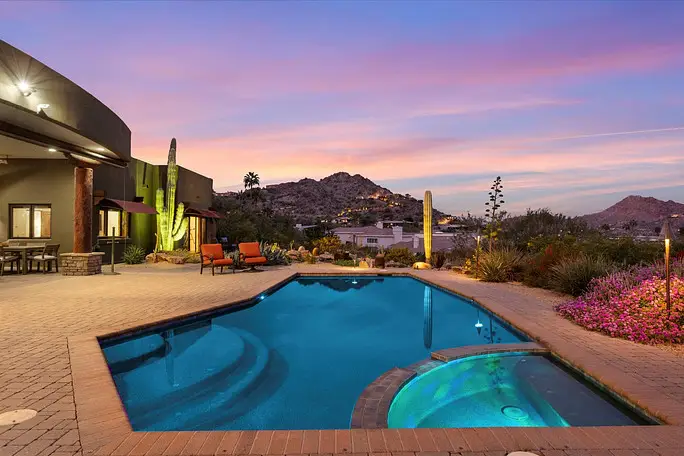
Pool light out? Ask Bahama Blue Pool & Spa for a free quote
Pool Light Equipment We Install




Why Install Pool Lighting in Cave Creek?
Warm evenings here run long, and the pool gets used after dark for months at a stretch. Lighting is what makes that possible without anyone guessing where the steps are.
What good pool lighting actually buys you:
- Visibility of steps, benches and the drop into the deep end
- Someone in the water can be seen from the house
- Color scenes and dimming for evenings when you want the mood instead of the floodlight
- Lower running costs than the incandescent fixture it replaces
- Control from the same app as the rest of your equipment
Worth thinking past the water, too. Steps, coping edges and the stretch between the house and the pool are where people actually trip, and that ground gets properly dark out here. We look at the whole picture while we are on site, and if a pool inspection is what you are after, the lighting circuit and bonding are part of what gets checked.
Pool Light Replacement and Lights That Stop Working
Start by finding out what actually failed, because the answer changes the cost by a lot.
A pool light that has stopped working in Cave Creek usually comes down to one of these:
- The bulb has gone, which is the cheapest outcome
- The GFCI or breaker has tripped and keeps tripping, which points at a fault
- Water has entered the fixture through a failed lens gasket
- The cord has been damaged inside the conduit
- The transformer has failed on a low-voltage system
- The fixture itself has corroded past saving
The order matters. A tripping breaker is the system telling you something is wrong, and resetting it repeatedly is the wrong response. That is the protection doing its job.
Water inside the fixture is the common one on older pools. The lens gasket is a consumable. It hardens in this heat and sun, and once it lets go the fixture floods.
We find out which of the six it is before quoting anything. “My pool light is out” covers everything from a bulb to a full replacement.
Pool Light Repair or Replacement?
On a Cave Creek pool, repair when the fixture housing is sound and the failure is a serviceable part. A bulb, a lens gasket, a transformer, or a tripped circuit that traces to something fixable.
Replace when the housing has corroded, the cord is damaged inside the conduit, or the fixture has flooded repeatedly. Replace too when the part no longer exists, which happens often on lights fitted twenty years ago.
There is a third option people forget. If your fixture is an old incandescent and it has failed, replacement is the moment to go LED. You are paying for the labor either way.
One caution worth stating plainly. An underwater light fault is not like a pump fault. A defective fixture can put a charge into the water around it. A light that trips its breaker, shocks anyone, or tingles on contact means the pool stays closed until someone qualified has looked at it.
LED Pool Lights and Color Changing Options
LED is what goes into a Cave Creek pool now, and the reasons are boring and good.
They draw a fraction of the power of the halogen or incandescent fixture they replace, up to around 80% less. They also last far longer, commonly 30,000 to 50,000 hours, which matters when replacing one means getting into the pool.
Color is the part people actually notice. A color changing LED will do fixed colors, slow fades and preset light shows. On a pool and spa combination you can run both to the same scene. Single-color LEDs in plain white are brighter than the incandescent they replace and cost less to fit.
Retrofitting LED Into an Existing Niche
You usually do not need a new niche. Most LED fixtures drop straight into the housing already in your pool wall. That is what makes an LED upgrade a much smaller job than a first-time installation, and it can often be done without draining the pool.
What has to be checked is the voltage the existing circuit runs at and whether the old cord and conduit are sound. A retrofit into a bad circuit is a new light on an old problem. We reseal and pressure-test the niche and conduit as part of the work.
Halogen Replacements
We still fit halogen where an LED retrofit will not go, or where a like-for-like swap on a legacy system is the sensible answer. It costs less up front and more to run, and we will tell you which way the numbers fall on your pool.
Pool Light Brands We Install
Our pool light installation work covers the lighting manufacturers found on Cave Creek pools.
- Pentair: IntelliBrite and MicroBrite
- Jandy: WaterColors and Infinite Series
- Hayward: ColorLogic and CrystaLogic
- PAL Lighting and CMP Brilliant Wonders
They differ in beam spread, brightness, control options and color quality, which sounds like marketing until you see two of them in the same pool. We walk you through it against your pool’s size, shape and how you use it.
Automation and Control
If you want the lights on a schedule or on your phone, we integrate them with Pentair IntelliCenter and IntelliTouch, Hayward OmniLogic and OmniHub, Jandy iAquaLink, and Intermatic controllers.
Set up properly, the lights come on at dusk without anyone touching anything, and scenes run across every fixture at once. Pairing lighting with the rest of your pool automation is what makes that work.
Wet Niche and Dry Niche Pool Lights
Two types, and on a Cave Creek pool yours is almost certainly the first.
A wet niche fixture sits in a housing open to the pool water. The water surrounds the light and cools it, and the fixture comes out on its cord for servicing. Nearly every residential pool here has these.
A dry niche fixture sits behind a window in the pool wall, sealed away from the water. It gets serviced from behind, so nobody has to get in the pool. More common on commercial installations.
The distinction matters because it decides how the light is serviced, what fixture fits, and whether anyone has to get in the water to do it.
If you are not sure which you have, it is a wet niche if the light comes out of the wall on a cord when the screw is released.
Nicheless systems are the third option, and they turn up on newer builds and some renovations. Those we fit as well.
The Electrical Rules Behind a Pool Light
This is the part that separates a pool light installation from an ordinary light fitting, and it is governed by NEC Article 680.
GFCI Protection
A ground fault circuit interrupter compares the current going into a circuit with the current coming back. When a person is being shocked, current escapes to ground and the two stop matching. At a difference of about 5 milliamperes, the GFCI opens the circuit.
Those numbers are worth understanding. Around 10 milliamperes is roughly the point where a person can no longer let go of what they are holding. At 18 milliamperes the chest muscles can contract hard enough to stop breathing. A GFCI is built to cut the circuit well below either.
The National Electrical Code requires GFCI protection in three places that matter here. Underwater lighting above 15 volts. Lighting between five and ten feet of the pool wall. And 125-volt receptacles within twenty feet of the water.
Here is the part that matters in an older neighborhood: pools more than about thirty years old may have no GFCI protection on the underwater lighting circuit at all. Cave Creek has plenty of pools that old. If nobody has checked yours, nobody knows.
Bonding
Bonding ties every metal part around the pool to the same electrical potential with solid copper wire. No voltage difference then exists between two things a swimmer might touch at once.
The classic injury is someone holding a metal ladder with one hand while a foot touches the metal ring of a faulty light. Two objects, two different potentials, and a body completing the path.
Article 680 requires bonding of the reinforcing steel in the shell and deck, metal fittings like ladders and handrails, the metal parts of circulation equipment including pump motors, the underwater lighting itself, and fixed metal within five feet of the pool wall.
Bonding and grounding are not the same thing, which trips people up. Grounding gives fault current a low-resistance path away. Bonding makes sure everything you can touch sits at the same potential in the first place.
Why This Is Not a Weekend Job
Between 2003 and 2014 the Consumer Product Safety Commission recorded fourteen deaths from electrocution in swimming pools.
Underwater lighting is on the short list of things that cause them, along with pumps, extension cords and outlets near the water. Changing a bulb is within reach of a careful homeowner. Anything touching the circuit, the cord, the niche or the bonding belongs with someone qualified to work on electrics around water.
Do You Have to Drain the Pool to Replace a Light?
Usually not.
A wet niche fixture pulls out of its housing on its cord and comes up to the deck. There is normally enough cord coiled behind the niche to reach. The lens, gasket and lamp are serviced there, in the dry, and the fixture goes back in.
The water level does often need to drop below the niche for part of the work, which is a different thing from draining the pool. On a Cave Creek pool that means a short partial drawdown and no refill.
Draining becomes likely when the conduit or the niche itself is replaced, or when a fixture goes in where none existed before. Cutting into a pool wall is the job that needs the water out of the way.
Never drain a pool here without asking someone first, by the way. Empty pools in dry ground can float, and in Arizona that happens to real pools.
What Pool Light Installation Costs
Priced as the fixture and the work, and which one dominates depends entirely on what you are having done.
An LED retrofit into a sound existing niche is the cheap end. The housing, conduit and circuit are already there, and the labor is short.
A replacement fixture on an existing circuit sits in the middle. A first-time installation into a pool that never had a light is the expensive end. That means a niche, a conduit run, a circuit and the electrical work to tie it all in.
What moves the number:
- Whether a niche and conduit already exist
- Whether the circuit has GFCI protection already, or needs it added
- Whether the existing cord and conduit are sound
- LED or halogen, and single color or color changing
- How many fixtures, since a large pool may want more than one
We quote the fixture and the installation separately. Every pool light installation quote in Cave Creek is broken out that way.
Our Pool Light Installation Process
1. Finding Out What You Have
Fixture type, niche type, voltage, the state of the cord and conduit, and whether the circuit has GFCI protection. Every pool light installation in Cave Creek starts here. On a light that has failed, this is also where we work out what broke.
2. Recommending the Fixture
LED or replacement like-for-like, single color or color changing, and how many. If your pool already runs automation, we check the fixture will work with it.
3. Electrical Preparation
Transformers, junction boxes, bonding connections and conduit get upgraded where the job needs it. This is the step that decides whether the installation is safe, so it is not one we skip to save an hour.
4. Lowering the Water If It Is Needed
Only as far as the job requires, which usually means below the niche and nowhere near empty.
5. Fitting and Sealing
Fixture into the niche, new lens gasket, correct cord routing, and the housing sealed properly. A gasket that is not seated is the reason a new light floods in its first season.
6. Testing and Handover
We power it up, verify the GFCI trips as it should, check the colors and scenes if you have them, and set the schedule. Then we show you how to run it.
We install on gunite, fiberglass and vinyl pools, on spa-only systems, on pool and spa combinations, and on rental or vacation properties.
Book Your Pool Light Installation
Tell us whether your light has failed or you are adding one, and roughly how old the pool is. The age tells us most of what we need to know about the circuit before we arrive.
Call (480) 800-0993, email info@bahamabluepoolandspa.com, or schedule service online. Doing more on the pad at the same time? There is pool pump installation, pool filter installation and pool heater installation.
We cover Cave Creek, Carefree, Desert Hills, Tatum Ranch, Desert Ridge, North Phoenix and North Scottsdale. The full service area is here.
Our Service Areas
- Desert Ridge
- Tatum Ranch
- Scottsdale
- Cave Creek
- North Phoenix
Pool Light Installation Questions
What Cave Creek homeowners ask about pool lights. If yours is not here, call (480) 800-0993.
It depends on what exists already. An LED retrofit into a sound niche is the cheap end, since the housing and circuit are there. A first-time installation needs a niche, conduit and circuit. We quote fixture and labor separately.
Often yes. A bulb, a lens gasket or a failed transformer are all serviceable on a sound fixture. Replace when the housing has corroded, the cord is damaged, or the fixture has flooded more than once.
Usually. A wet niche fixture pulls out of its housing on its cord and gets serviced on the deck. The water often needs to drop below the niche, which is a partial drawdown and not a full drain.
Because something is faulting to ground, which is exactly what the GFCI is built to catch. Common causes are water inside the fixture, a damaged cord, or a failed lamp. Repeatedly resetting it is the wrong response.
Changing a bulb is within reach for a careful homeowner. Anything touching the circuit, cord, niche or bonding is not, because a faulty underwater light can put a charge into the water around it.
Generally yes. LED draws a fraction of the power of the halogen it replaces and lasts far longer. That matters when replacing one means getting into the pool. Most retrofit into the existing niche.
The housing set into the pool wall that the fixture sits in. A wet niche is open to the pool water and the light comes out on its cord. A dry niche is sealed behind a window and serviced from behind.
Yes, where underwater lighting operates above 15 volts, under NEC Article 680. Pools more than about thirty years old may have no GFCI on the lighting circuit at all. Worth checking on any older Cave Creek pool.
Bonding ties metal parts around the pool to the same electrical potential with copper wire. No voltage difference then exists between two things a swimmer can touch. Article 680 lists underwater lighting as an item that must be bonded.
An LED retrofit into an existing niche is usually a single short visit. A replacement fixture on a sound circuit is similar. A first-time installation needing a niche, conduit and new circuit takes considerably longer.