
Green Pool Cleanup in Cave Creek, AZ
Tested first, then treated. Call (480) 800-0993.

Schedule Service!
Professional Green Pool Cleanup in Cave Creek, AZ
A clear pool can go green in under a day. Algae reproduce fast when the conditions suit them, and a Cave Creek summer suits them.
So if you uncovered the pool this morning and it looks like a pond, nothing unusual has happened. Your chlorine ran out, or it stopped working, and the algae that blow into every outdoor pool in this valley took the opening.
Green pool cleanup in Cave Creek, AZ is our green to clean service, and it starts with a test kit before anyone opens a jug of shock. What the numbers say decides whether this is a two-day job or a two-week one.
We run it across Cave Creek, Carefree, Desert Hills and north Maricopa County, alongside the rest of our pool services.
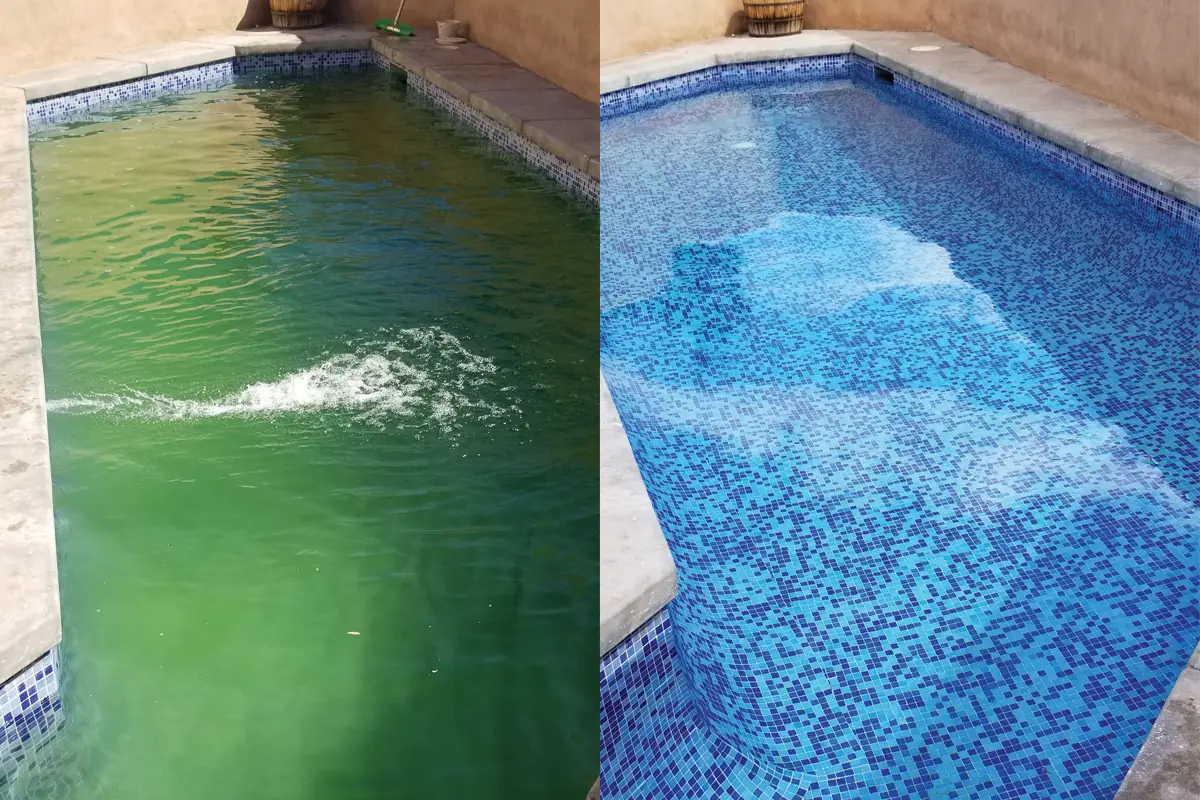
Pool gone green? Ask Bahama Blue Pool & Spa for a free quote
Pool Equipment We Work With




Why Did My Pool Turn Green?
Algae spores land in your pool constantly. Millions of them blow into outdoor pools every day across Cave Creek, and some arrive in the fill water itself. They are not the problem.
The problem is when nothing is there to kill them.
Pool algae removal is normally something chlorine does for you, quietly, before you ever see a bloom. When free chlorine drops, or gets chemically tied up, the spores that land that afternoon have nothing standing in their way. Given warm water and sun, they can turn a clear pool green in less than a day.
What makes a Cave Creek pool go green:
- The pump ran too few hours during a hot stretch
- Chlorine ran out while nobody was home
- A monsoon dumped organic debris in and burned the chlorine off
- Stabilizer levels drifted too high and locked the chlorine up
- The filter stopped moving enough water to matter
- A dead spot in the circulation left one corner untreated
That last pair is where most stubborn green pools live, and it is the part homeowners almost never check.
Green, Mustard or Black: Which Algae You Have
Three types show up in Cave Creek pools, and they are not equally difficult.
Green algae is by far the most common and the easiest to deal with. It clouds the water, turns it green, and responds well to chlorine and brushing.
Mustard algae, sometimes called yellow, sits on walls and in shade and looks a bit like sand or pollen. It brushes away easily and comes straight back, because it resists chlorine better than green does.
Black algae is the one nobody wants. It roots into plaster, protects itself with a layer that chlorine struggles to get through, and it comes back from what looks like nothing. Black algae takes repeated treatment and hard brushing, and sometimes it leaves marks behind even after it is dead.
Knowing which one is in your pool changes the plan, the chemicals and the time. That is the first thing we establish on site.
Why Shocking a Green Pool Sometimes Does Not Work
This is the part that frustrates people, and on a Cave Creek pool it has a specific explanation.
You can pour shock into a green pool, watch the chlorine read high on the test strip, and still have green water three days later. The chlorine is there. It is just not doing anything.
The usual culprit is cyanuric acid, the stabilizer in every trichlor tab and every bag of dichlor.
Stabilizer is genuinely useful in Arizona. Unprotected chlorine gets destroyed by sunlight in under an hour, and with cyanuric acid in the water your chlorine residual lasts three to ten times longer. Without it you would be chasing the chlorine all summer.
The catch is that it never leaves on its own. Every stabilized tab you drop in the skimmer adds more, water evaporates and leaves it behind, and the level climbs season after season.
Cyanuric acid should sit between 30 and 50 ppm. Well above that, and high stabilizer raises your risk of algae, because the chlorine you are paying for becomes progressively less available to kill anything. Cyanuric acid has no disinfecting power of its own.
So when a pool will not clear despite good chlorine numbers, we test the stabilizer. If it is high, more shock is not the answer and never will be.
Do You Need to Drain the Pool?
Usually not. Sometimes yes, and on a Cave Creek pool the test results tell us which.
Most green pools clear without draining. Chlorine, brushing, filtration and time will do it, and that is by far the cheaper route.
Draining or partially draining comes into it for one main reason: some things in pool water can only be removed by dilution. Cyanuric acid is the main one, and there is no chemical that takes it out. Nitrates are the same story. When those are the reason the pool will not hold chlorine, replacing water is the only lever that works.
We would rather lower the level partway and refill than drain the whole thing. You get the dilution without the risk that comes with an empty shell, and it uses less water.
If the plaster is stained once the water clears, that is a separate conversation and a separate job. It is an acid wash, and it only makes sense after the algae is gone.
How Long Does a Green Pool Cleanup Take?
Depends almost entirely on how far gone it is and what the stabilizer reads. Most Cave Creek jobs fall into one of two brackets.
A pool that went green last week, with normal chemistry underneath, usually clears in two to four days. Most of that is filtration time, since killing algae is fast and getting the dead algae out of the water is not.
A pool that has been green for a month, or has black algae, or has stabilizer through the roof, takes longer and may need more than one treatment. If water has to be replaced to bring the stabilizer down, add the refill time on top.
The honest version: anyone who quotes you a fixed turnaround before testing the water is guessing.
We will tell you what we think after the first test, and we will tell you if we think it is going to be a slow one.
What Green Pool Cleanup Costs
Priced by the size of the pool and how far gone it is. Every green pool cleanup quote in Cave Creek is built the same way.
A recently green pool with sound chemistry is the cheap end, because it is mostly chemicals and filter time. Longer neglect means more chemical, more visits and more filter cleaning. Green pool cleaning cost climbs with every week it sits.
What moves a green pool cleanup quote:
- How long the pool has been green
- Whether it is green, mustard or black algae
- Whether the stabilizer level means water has to be replaced
- Whether the filter and pump are working properly
- How much debris is on the floor before anyone starts
A failing pump or filter is worth knowing about early, because a green pool cleanup on a system that cannot circulate is money spent twice. If that turns out to be the issue, it is a pool repair first.
Our Green to Clean Process
1. Test Before Anything Else
Free chlorine, combined chlorine, pH, alkalinity, calcium hardness and stabilizer. Every green to clean job in Cave Creek starts here. The stabilizer reading decides the whole approach, so nothing goes in the water until we have it.
2. Clear the Debris
Leaves and heavy debris come out first. Shocking a pool with a layer of organic matter on the floor just burns chemical on the debris.
3. Shock and Treat
Chlorine to a level the water actually needs, with algaecide where the type of algae calls for it. Black and mustard algae get a different treatment from ordinary green.
4. Brush and Circulate
Brushing matters more than people expect, particularly with black algae, because it breaks the protective layer and lets chlorine reach the cells. We also look for dead spots where circulation is not reaching.
5. Filter and Vacuum
This is where most of the time goes. Dead algae has to come out of the water, which means running the filter hard and cleaning it repeatedly as it loads up.
6. Rebalance
Once the water is clear we set pH, alkalinity, calcium hardness and stabilizer properly, so the pool is not sitting one hot week away from doing it again.
Green Pool Cleanup for Every Pool and Every Situation
We recover plaster and gunite pools, PebbleTec, PebbleSheen and exposed aggregate finishes, vinyl liner and fiberglass pools, above-ground systems, pool and spa combinations, HOA and community pools, and rental or vacation properties.
The situations repeat more than the pools do. What we see most often in Cave Creek:
- Seasonal pollen and windblown dust feeding rapid growth through the warm months
- Mature trees dropping leaves and seeds, pushing chlorine demand up
- Poor circulation from worn equipment, a clogged filter or a failing pump
- A new owner taking over a pool where the chemistry was not kept up
- Mineral-heavy water driving chlorine demand, scaling and clarity problems
- Heavy shade keeping a corner cool and dark, where sanitation slips first
- Post-storm runoff and debris overwhelming the system in a day
If you have guests arriving, say so when you call. We can prioritize scheduling on a rental or vacation property.
Is a Green Pool Dangerous?
More than most people assume, and in Cave Creek heat it gets worse quickly.
Algae harbors bacteria. A pool that has been green for weeks has become a place where other things are living. That is why keeping water free of algae matters more than keeping it merely clear. The CDC covers the illness side of recreational water in more detail.
The other risk is physical and it gets overlooked. Algae on the pool floor is slippery, and the place where that matters most is the slope where the shallow end drops away. Someone stepping onto that transition can slide into deep water.
If you cannot see the bottom of your pool, nobody should be swimming in it. That is not caution, it is that you cannot see a person on the floor.
Keeping a Cave Creek Pool From Going Green Again
Getting it clear is the easy half. Staying clear is what actually saves money.
You cannot control most of what causes algae, because sun, heat and humidity are what they are out here and spores blow in every day whatever you do.
What keeps a Cave Creek pool clear:
- Run time long enough to turn the water over properly in summer heat
- Chlorine that never drops to zero, even for a weekend
- Stabilizer kept in range instead of climbing every season
- A filter that gets cleaned when pressure says so
- Circulation that actually reaches the corners, with no dead spots
The stabilizer one is worth repeating because it is slow and invisible. A pool running on trichlor tabs climbs a little every month, and nothing tells you until the chlorine stops working.
Phosphates are worth a mention too, since they feed algae and arrive from fill water, fertilizer, and anything that blows in off the desert. Algae stores phosphate inside itself, so a bloom brings its own food supply with it. We can strip phosphates out, and on a shaded yard an algae inhibitor earns its keep.
A weekly pool service route is doing all of that in the background, and it is considerably cheaper than a green pool cleanup twice a summer.
Book Your Green Pool Cleanup
Tell us roughly how long it has been green, whether you can see the bottom, and whether the pump is running. Photos help.
Just bought a house with a green pool? A pool inspection will tell you whether the equipment works before you spend anything on the water.
Call (480) 800-0993, email info@bahamabluepoolandspa.com, or schedule service online.
We cover Cave Creek, Carefree, Desert Hills, Tatum Ranch, Desert Ridge, North Phoenix and North Scottsdale. The full service area is here.
Our Service Areas
- Desert Ridge
- Tatum Ranch
- Scottsdale
- Cave Creek
- North Phoenix
Green Pool Cleanup Questions
What Cave Creek homeowners ask when the pool has gone green. If yours is not here, call (480) 800-0993.
How to clean a green pool fast: test first, then shock to the level the water needs, brush, and run the filter hard. Most of the time goes on filtration, since killing the algae is the quick part. If stabilizer is high, no amount of shock clears it quickly.
A recently green pool with sound chemistry is usually two to four days, most of it filtration. Long neglect, black algae, or a high stabilizer reading that needs water replaced will all extend that.
Usually yes. Most green pools clear with chlorine, brushing and filtration. Draining or partial draining comes in when cyanuric acid or nitrates are too high, because dilution is the only way to reduce those.
Chlorine at the right level, with brushing to break up what is clinging to surfaces. Algaecide helps with mustard and black algae. Nothing works fast if the chlorine is locked up by high stabilizer.
Most often the stabilizer is too high, so the chlorine reads fine on a test but cannot do the work. Check cyanuric acid. Also check that the pump is running and the filter is not blocked.
It depends on pool size and how long it has been green. A recent bloom with good chemistry is mostly chemicals and filter time. Long neglect, black algae, or water replacement all add to it.
It is the stabilizer in trichlor and dichlor products. It protects chlorine from sunlight, which matters in Arizona, but it builds up over time. Above roughly 30 to 50 ppm it raises your risk of algae.
No. Algae harbors bacteria, and algae on the floor makes the slope into the deep end slippery. If you cannot see the bottom, you also cannot see a person on it.
Green is most common and easiest to clear. Mustard sits in shaded areas, brushes off and returns. Black algae roots into plaster, resists chlorine and needs repeated treatment with hard brushing.
It can. Deep organic staining sometimes remains after the water is clear, especially after a long bloom. That is an acid wash job, and it is only worth considering once the algae is gone.