
Pool Filter Repair in Cave Creek, AZ
Cartridge, DE and sand filters diagnosed and repaired. Call (480) 800-0993.

Schedule Service!
Professional Pool Filter Repair in Cave Creek, AZ
The Gauge Usually Names the Fault Before We Arrive
Pool filter repair in Cave Creek, AZ usually starts with one of three things. The pressure gauge is climbing, the water will not clear, or something is coming back into the pool that should have stayed in the filter.
Those are different faults with different fixes, and the gauge tells us most of what we need before we open anything.
We repair cartridge, DE and sand filters across Cave Creek, Carefree, Desert Hills and the rest of north Maricopa County. Most jobs are a cracked or worn part inside a tank that is otherwise fine. It is one piece of the pool cleaning and maintenance picture.
If yours turns out not to be worth fixing, we will say so. That is a pool filter installation, and it is a different conversation.
Filter acting up? Ask Bahama Blue Pool & Spa for a free repair quote
Pool Filter Brands We Repair




Pool Filter Symptoms and What They Mean
Nobody searches for pool filter repair until something looks wrong. The symptom usually names the fault before we get there.
Filter Pressure Too High
Pressure climbing 8 to 10 psi above its clean reading is the normal signal to backwash or clean the media. That much is ordinary maintenance.
It becomes a repair when pressure stays high after cleaning. The usual causes are a media bed blocked with mineral deposits, a partly closed valve, or an obstruction in the return line.
Either way it is better dealt with early, since sustained high pressure is what breaks the laterals and manifolds underneath it.
Filter Not Building Pressure
Low pressure with weak flow at the returns points at the suction side of the system. We check the pump basket and the skimmer strainer first, then the suction valves, then the impeller. A failing impeller is pool pump repair work.
A damaged or obstructed impeller produces exactly this. It gets misdiagnosed as a filter fault more often than anything else on the pad.
Pool Filter Leaking
Leaks show up at the clamp band, the tank O-ring, the drain plug, or the valve. Most are a perished seal and a same-visit fix.
A cracked tank is the one that ends the conversation, because pressurized plastic that has already failed once cannot be patched safely.
Sand or DE Coming Back Into the Pool
Sand in the pool means a broken under-drain lateral, and there is little point looking anywhere else.
Why it broke is the more useful question. High filter pressure damages laterals, so if we replace them without finding what drove the pressure up, you will see sand again.
DE coming back through the returns is a torn grid, a bad manifold, or a grid that is not seated properly.
Cloudy Water With a Filter That Seems Fine
Filter media wears out from the inside. Once it tears or lets water past, the pool gets unfiltered water back and the chemical demand climbs with it.
You can run a filter in that state for months without knowing. This is why we examine the media itself as well as the pressure reading.
Short filter cycles point the same direction. If you are cleaning far more often than you used to, something is blocked, bypassed, or feeding chemicals into the line ahead of the filter when it should go in after.
Pool Filter Repairs We Handle
Cartridge Filter Repair
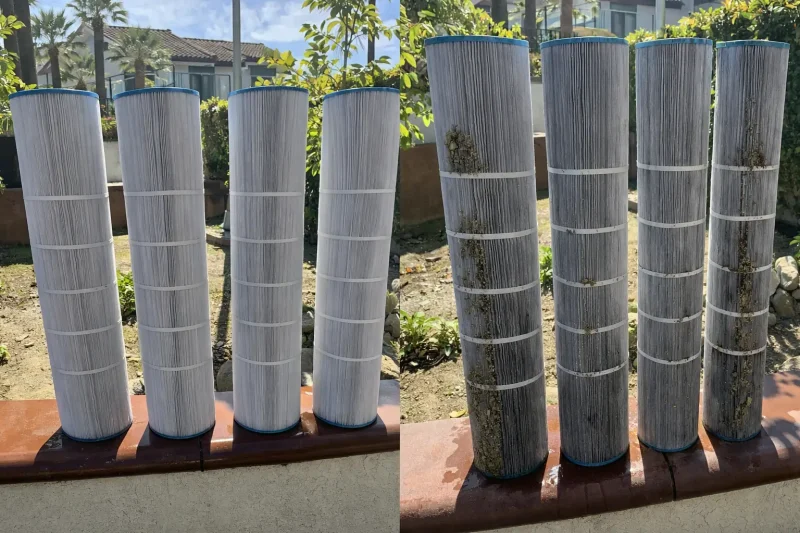
Cartridge elements come out and go back in by design, so a torn or collapsed cartridge is a parts job. We also find elements that never seated properly on the center pipe, which sends unfiltered water straight back to the pool.
Cartridge media filters down to roughly 10 to 25 microns and lives in a compact tank, which is why it is on so many Cave Creek pools.
DE Filter Repair
DE filters catch the finest particles of any pool filter, down around 2 to 6 microns, because the powder forms a cake on cloth-covered grids.
That cake is also what goes wrong. Grids tear, manifolds crack, and body coat builds up until coats on neighboring grids touch, which is called bridging. We strip the tank, inspect every grid, and replace what has failed.
Sand Filter Repair
Laterals, the distributor, the air strainer and the valve are the parts that fail. Sand itself lasts a long time, usually somewhere between 5 and 15 years.
Hard water shortens that. Minerals and organic load carve paths through the bed. Water then runs past the media instead of through it. The term for that is channeling, and it is the reason a Cave Creek sand filter can look fine and filter badly.
Replacing worn media is a sand change, not a repair, and we will tell you which one you need.
Multiport and Backwash Valve Repair
Valves leak internally long before they leak visibly. A hardened spider gasket sends water to waste while the handle still says filter, so you lose water and chemicals with nothing visible to explain it.
Pool Filter Problems We Repair
The faults we see most often, across all three filter types:
- Filter pressure too high after cleaning or backwashing
- Filter not building pressure, with weak flow at the returns
- Pool filter leaking at the clamp band, tank O-ring or drain plug
- Sand returning to the pool through a broken under-drain lateral
- DE returning to the pool through torn grids or a cracked manifold
- Torn or collapsed cartridge elements, or elements seated wrong on the center pipe
- Multiport or backwash valve leaking internally past a worn gasket
- Filter media blocked with calcium, restricting flow and driving pressure up
- Air pulling into the system through the suction side
- Cloudy water and repeat algae traced back to filtration failure
How Long Should a Pool Filter Last?
It depends which part you mean, and that distinction decides most pool filter repair calls we take in Cave Creek.
Cartridge elements are consumables. Heavy commercial use retires one in about six months, and a home pool gets considerably longer, but the element is a wear part either way.
Sand lasts roughly 5 to 15 years before it needs changing. DE grids sit in between and depend almost entirely on how hard the water runs.
Tanks tend to outlive everything inside them, which is why most pool filter repair we do in Cave Creek turns out to be a sound tank with one failed component in it.
Why Cave Creek Water Is Hard on Filters
Filters here fail faster than the same equipment in softer water, and hardness is most of the reason.
Calcium comes out of solution onto anything it runs through, including filter media. Calcified media restricts flow and drives pressure up. Pressure is what cracks laterals and manifolds. Scale on the media is also what turns a sand bed into a channeled one.
Dust loads the picture after a monsoon blow, and heat keeps the whole system running longer through summer, so a filter here logs more hours a year than the same model would somewhere milder.
Keeping the water balanced is the cheapest filter repair there is. That is what a weekly pool service route does at the equipment pad. A filter on a maintained pool outlasts one on a neglected pool by years.
What Happens on a Pool Filter Repair Visit
We inspect the whole filtration system: tank, internals, plumbing, valves, pressure readings and pump performance. A filter symptom is frequently a pump problem wearing a disguise.
We tell you what failed and why it failed. The why is the useful half, because a lateral that broke from high pressure will break again if nothing addresses the pressure.
We fit manufacturer-matched parts, bring the system back to proper flow, and test it before we leave. We check the water balance on the way out too, since a filter that has been underperforming has usually been dragging the chemistry with it.
Filter faults rarely travel alone. If the pump or the pool heater is heading the same way, we will flag it so you are not finding out next month. That work sits under pool repairs.
Should You Repair or Replace Your Pool Filter?
Four things decide it: what actually failed, the age of the tank, whether parts are still made for that model, and how the filter is sized for the pool.
Replace when the tank is cracked, when the model is discontinued and parts have dried up, or when the filter was undersized to begin with. An undersized filter fails repeatedly no matter how many parts go into it.
Repair is the right call in most other cases. A tank with a torn grid or a broken lateral needs a part fitted, and that is the whole job.
There is a wrinkle if you do replace. Changing a filter changes the hydraulics, so we check flow rate and total dynamic head against the system afterwards for compliance with the federal Pool and Spa Safety Act, which governs drain and circulation safety. It is not a swap-and-go job, and it is part of why we treat it as a pool equipment installation.
Why Pool Filter Repair Is Not a DIY Job
Plenty of pool maintenance makes sense to do yourself. This is the exception, and the reason is pressure.
A pool filter is a pressure vessel. Air collects at the highest point in the system, which is the filter tank, and air compresses. Open a clamp band or move a valve with that pressure still in the system and the tank can separate violently. That causes serious injuries, and it has killed people.
The procedure is to shut the pump down and open the air bleed before anything gets loosened. Every time, including when you are sure it is already off.
If you are comfortable with that and you know your system, a clamp O-ring is a reasonable afternoon. If you are not, the call costs less than the emergency room.
Book Your Pool Filter Repair
Tell us what the gauge reads and what the water looks like. We can usually narrow it before we arrive. Buying the house? A pool inspection covers the filter along with everything else. Call (480) 800-0993, email info@bahamabluepoolandspa.com, or schedule service online.
If the filter is dirty rather than broken, you want pool filter cleaning instead, and we will tell you if that is all it needs.
We cover Cave Creek, Carefree, Desert Hills, Tatum Ranch, Desert Ridge, North Phoenix and North Scottsdale. The full service area is here.
Our Service Areas
- Desert Ridge
- Tatum Ranch
- Scottsdale
- Cave Creek
- North Phoenix
Pool Filter Repair Questions
What Cave Creek homeowners ask us most about filter faults, lifespan and cost. If yours is not here, call (480) 800-0993.
Pool filter repair is priced by what failed. A clamp O-ring or a seated element is a small job, while grids, laterals or a manifold cost more in parts. We diagnose first and quote before any work starts.
Filter pressure climbing 8 to 10 psi above its clean reading normally means the media needs cleaning. If pressure stays high afterwards, the likely causes are mineral-blocked media, a partly closed valve, or a blocked return line.
Sand in the pool means a broken under-drain lateral inside the filter. Replacing the lateral is only half the repair, because high filter pressure usually broke it. We find the pressure cause too.
No. A filter tank is a pressure vessel, and plastic that has already failed under pressure cannot be safely patched. A cracked tank needs replacing. Internal parts like grids, laterals and manifolds we repair routinely.
Tanks often outlast everything inside them. Sand lasts roughly 5 to 15 years. Cartridge elements are wear parts measured in months to a couple of seasons, and DE grids fall in between depending on water hardness.
Filter media can tear or let water past internally, sending unfiltered water back while pressure still reads normal. Cloudy water with a clean filter usually means worn media, a torn element, or a seating fault.
Leaking clamp bands and O-rings, torn cartridge elements, cracked DE manifolds and grids, broken sand laterals, failed multiport valve gaskets, and media blocked with calcium. Hard water drives most of them in Cave Creek.
Repair when a part failed inside a sound tank, which covers most cases. Replace when the tank is cracked, parts for the model are no longer available, or the filter was undersized for your pool and fails repeatedly.
Only with the pump off and the air bleed valve open first. A pressurized filter tank can separate violently when someone disturbs a clamp or valve, which causes serious injury. Release the pressure before touching any fitting.
Yes, all three. Cartridge repairs are usually elements and seating, DE work is grids and manifolds, and sand filters are laterals, distributors and valves. We service the major brands including Hayward, Pentair, Jandy and Zodiac.