
Pool Acid Wash in Cave Creek, AZ
Drained, stripped, neutralized and rebalanced properly. Call (480) 800-0993.

Schedule Service!
Professional Pool Acid Wash in Cave Creek, AZ
An Acid Wash Does Not Clean Plaster, It Removes a Layer of It
An acid wash does not clean your plaster. It removes a thin layer of it.
That is worth understanding before you book one, because it is what makes an acid wash work and it is also why you cannot keep doing it. Plaster is a finite thickness, and every wash spends some of it.
Done at the right time on the right pool, it takes a surface that has gone gray and blotchy back to something close to the original finish. Done on thin or brittle plaster, it causes the damage it was meant to fix.
A pool acid wash in Cave Creek, AZ is sometimes called a drain and clean. We do them across Cave Creek, Carefree, Desert Hills and north Maricopa County, alongside the rest of our pool services.
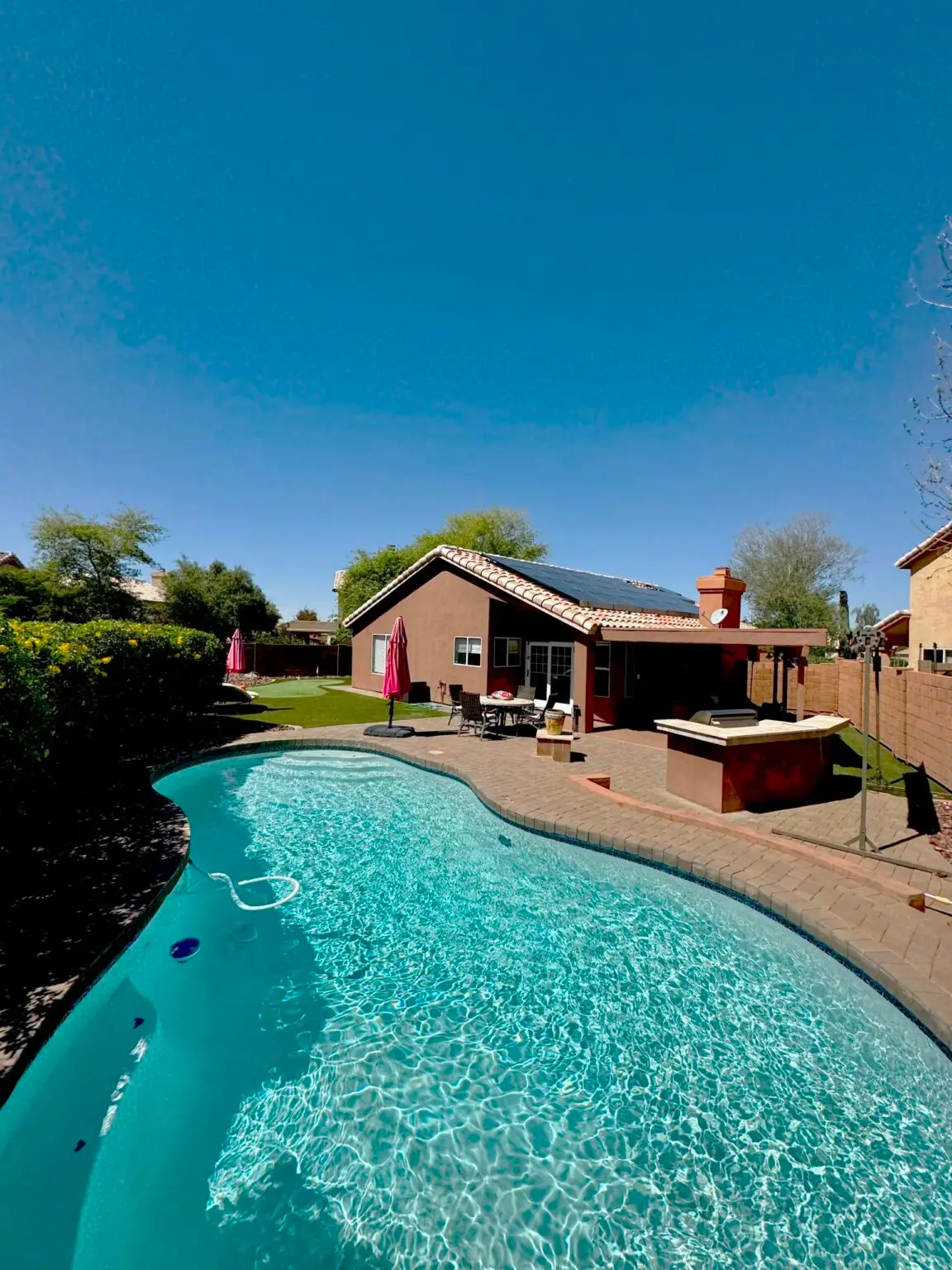
Stained plaster? Ask Bahama Blue Pool & Spa for a free acid wash quote
Pool Equipment We Work With




What Is a Pool Acid Wash?
A pool acid wash in Cave Creek runs the same way anywhere. The pool gets drained, a diluted acid solution goes onto the exposed plaster, the surface is scrubbed, then it is neutralized, rinsed and refilled.
What the acid does is dissolve the top layer of the plaster along with whatever is embedded in it. You are taking away the surface the stain lives in, which is why it works on things that will not scrub out.
That makes acid washing a pool the last resort in pool stain removal, and the one that works when the gentler methods have failed.
Stains an acid wash removes that nothing else touches:
- Mineral and metal staining from iron, copper and manganese in hard water
- Calcium scale on walls, waterline, steps and benches
- Algae scarring left behind in plaster pores after a bloom has cleared
- Black algae streaks still embedded after treatment
- Gray, yellow or blotchy discoloration from years of sun and imbalance
- Leaf and debris marks driven into the surface after storms
And it is also why an acid wash counts as a restoration instead of a cleaning. If brushing, shocking or a stain treatment will do the job, those come first.
Find Out What the Stain Is Before You Spend Plaster
Metal stains and organic stains look alike on a wall and they respond to completely different things. Plenty of people book an acid wash without ever establishing which one they have.
Two tests you can do yourself, in about a minute each.
Crush a vitamin C tablet and hold it against the stain for thirty seconds. If the spot under it lightens, the stain is metal, because ascorbic acid pulls metal out of plaster. That is a stain treatment job, not a drain and clean.
Then take a chlorine tab and hold that against a different patch. If that patch lightens, the stain is organic and a chlorine wash will deal with it.
If neither does anything, you are most likely looking at calcium scale. Or a stain deep enough that only an acid wash will reach it.
This is the part of pool stain removal we would rather you did before calling a Cave Creek acid wash company, us included. It costs you a tablet and it can save you a layer of plaster.
Signs Your Cave Creek Pool Needs an Acid Wash
Run down this list before you call anyone. If none of it sounds like your pool, you do not need us for this.
- Discoloration will not lift after heavy brushing, shock or algaecide
- Calcium scale has built up on walls, the waterline, steps or benches
- Deep organic staining remains after a green pool has cleared
- Black algae spots stay embedded in the plaster after treatment
- The surface looks dingy, blotchy or uneven instead of bright and uniform
- Algae keeps coming back despite correct chemistry, which suggests spores trapped in the plaster pores
- The pool has not been drained or deep cleaned in five years or more
Cave Creek accelerates most of that. Hard water, long swim seasons, strong sun and post-storm debris all push a plaster surface harder than a milder climate would.
There is one on that list worth pausing on. Algae that returns on good chemistry usually means the plaster itself has become the problem. A porous or scarred surface gives spores somewhere to sit where the chlorine cannot easily reach them.
Pool Acid Wash or Chlorine Wash?
Different problems, different treatment, and picking wrong costs you plaster you did not need to spend.
Acid handles mineral problems. Scale, metal staining, hard water deposits, chemical discoloration that has set in over years, algae scarring left in the surface. It gets there by removing plaster.
Chlorine handles living things. Algae, mold, mildew, bacteria, a green pool where growth has taken hold on the walls. It disinfects and leaves the plaster alone.
Getting that backwards is the expensive mistake. Reach for acid on an organic problem and you have spent plaster on a job a chlorine wash would have done without touching the surface.
Sometimes both are right, usually on a pool that has been green a long time and has mineral problems underneath the algae. On a Cave Creek pool we look at the plaster, the staining, the pool’s history and the equipment before deciding which you need.
If your pool is actually green right now, start with green to clean. An acid wash is what you consider afterwards if stains remain once the water is clear.
How Often Should You Acid Wash a Pool?
Rarely, and the plaster arithmetic is why.
Because every wash removes a thin layer, most plaster pools can only take somewhere between one and three acid washes across their whole life. Spend them early and you are into resurfacing sooner than you needed to be.
How often to acid wash a pool, by condition:
- Every five to seven years on a well-maintained pool with light staining
- Every three to five years on a pool dealing with hard water, heavy debris or a long season, which describes most of Cave Creek
- After a serious green pool event, if staining is still there once the water clears
- When scale or discoloration is widespread and brushing and chemistry have stopped helping
If the plaster is already thin, chipping or brittle, an acid wash is the wrong call regardless of how it looks. At that point the options are a chlorine wash, targeted stain treatment, or resurfacing.
We check plaster condition before quoting, and we will tell you if the answer is no.
Draining a Pool for an Acid Wash
An acid wash means an empty pool, and an empty pool is not a neutral state. Pool draining is a service in its own right for exactly this reason.
Water in the ground pushes up against the underside of the shell. Full, the weight of the water holds everything down. Empty, that upward pressure has nothing working against it, and a pool can lift out of the ground.
What stops it is a hydrostatic relief valve, fitted at the lowest point of the pool. When ground water pressure builds under the shell, the valve opens and lets water in, which relieves the pressure. On some properties, well points in the deck feed a pump that draws the surrounding ground water down as well.
So the question before any drain is whether your pool has that protection and whether it works. Nobody checks a relief valve while the pool is full, because you cannot. It is the first thing we establish on any Cave Creek drain and clean.
That is the real reason a drain and clean is not a weekend project. Staining is a cosmetic complaint, and a shell that has moved in the ground is a structural repair on a completely different scale.
We also time the drain around the weather and how long the surface stays exposed, because bare plaster sitting dry in Arizona sun is its own problem.
What a Pool Acid Wash Costs
Priced by the size of the pool and the state of the surface, and those move independently.
Surface area sets the baseline. A larger pool takes more acid, more labor and more time to drain, rinse and refill.
Condition sets the rest. Light discoloration is one pass. Heavy scale, black algae or staining that has been building for a decade takes more work and sometimes more than one application.
What else shows up on a pool acid wash quote:
- Whether the pool needs a chlorine wash as well as an acid wash
- How much water has to be removed and where it goes
- Whether the plaster needs assessment before anyone commits
- The refill itself, which on a full-size pool is a real volume of water
Refilling is not free either, and Cave Creek fill water goes back in hard. That is part of why the balance afterwards matters so much.
Our Pool Acid Wash Process
1. Drain and Inspect
The pool comes down and the debris comes out. Every pool acid wash in Cave Creek starts here. With the surface exposed we look at the plaster properly: cracks, etching, hollow spots, how much thickness is left. Aggregate showing through is the tell. Once the pebble and sand start coming up through the finish, the plaster has already given what it has. This is the point where we would tell you an acid wash is the wrong idea.
2. Protect the Equipment
Fittings covered, features blocked off, valves checked, pump and filter shut down properly. The acid is meant for the plaster and nothing else on the pad.
3. Apply and Scrub
Diluted muriatic acid, applied evenly across the interior. The wall goes on wet first, because acid hitting dry plaster grabs unevenly and leaves streaks you cannot take back out. It foams as it reacts with the deposits, and then the surface gets worked by hand to lift scarring and scale the acid has loosened. We work in sections and rinse as we go, since the acid cannot be left to dry anywhere.
4. Neutralize and Rinse
A neutralizing agent such as soda ash goes on to stop the reaction, then the whole interior is rinsed. Skipping or rushing this step leaves acid working on plaster that has already given up what it was going to give.
5. Refill and Balance
The pool refills and we set the chemistry from the start: pH, alkalinity, calcium hardness and stabilizer. Fresh plaster is reactive and it wants balanced water immediately.
Why DIY Pool Acid Washing Goes Wrong
People do attempt this themselves, and the failures follow a pattern.
Too strong a mix, or left on too long, and you get etching. The surface comes out permanently rough and porous, holding stains worse than the one you started with. More acid does not reverse it.
Muriatic acid is hydrochloric acid. It burns skin, it damages eyes, and the fumes off a dry pool floor on a hot day are worse than people expect. NIOSH lists it as corrosive to eyes, skin and the respiratory tract. That is the short version of why it needs ventilation, protection and someone who has handled it before.
Then there is the water. Acid-contaminated wastewater does not belong in a storm drain or on the landscape, and disposal is a real responsibility with rules attached.
And underneath all of it sits the draining question above. The pool has to come down before any of this starts.
Changing a bulb or brushing a wall is homeowner work. A Cave Creek acid wash is not, and the failure mode is expensive.
Keeping Stains From Coming Back After an Acid Wash
Here is the part that decides whether you are doing this again in three years or in seven.
Everything an acid wash removes was put there by water that was not in balance. Scale forms when the water is saturated with calcium and drops it onto the surface. Etching and dissolved plaster happen when the water is aggressive and takes calcium back out. Both are the same mechanism running in opposite directions.
Calcium hardness wants to sit between 200 and 400 ppm. Cave Creek fill water arrives high, and it climbs further as water evaporates and leaves its minerals behind.
There is a local twist in the chemistry too. Calcium gets less soluble as temperature rises, which is the opposite of how most things behave. Hot water sheds calcium onto surfaces, which is why scale appears fastest on the heater, the spa and the waterline in an Arizona summer.
So a fresh acid-washed surface with the same unbalanced water on it will scale again. Keeping the water in range is what protects the work, and it is a large part of what a weekly pool service route is doing.
The white band at the waterline is the same mineral, and catching it early with pool tile cleaning is far cheaper than spending plaster on it later.
Book Your Pool Acid Wash
Tell us roughly how old the pool is, when it was last drained, and what the staining looks like. Photos help more than descriptions here.
Buying a house with a stained pool? A pool inspection will tell you whether the plaster can take a wash before you commit to anything.
Call (480) 800-0993, email info@bahamabluepoolandspa.com, or schedule service online.
We cover Cave Creek, Carefree, Desert Hills, Tatum Ranch, Desert Ridge, North Phoenix and North Scottsdale. The full service area is here.
Our Service Areas
- Desert Ridge
- Tatum Ranch
- Scottsdale
- Cave Creek
- North Phoenix
Pool Acid Wash Questions
What Cave Creek homeowners ask before booking an acid wash. If yours is not here, call (480) 800-0993.
Cost in Cave Creek is driven by pool size and how bad the staining is. A larger surface takes more acid, labor, draining and refilling. Heavy scale or black algae may need more than one application. We quote after seeing the plaster.
Rarely. Each wash removes a thin layer of plaster, so most pools can only take one to three over their lifetime. Five to seven years is reasonable on a well-kept pool, three to five in hard water.
Acid wash for mineral problems: scale, metal stains, hard water deposits. Chlorine wash for biological problems: algae, mold, bacteria. Chlorine washing does not remove plaster, so it is the safer choice when the issue is organic.
We would not recommend it. Muriatic acid burns skin and eyes, the fumes in a drained pool are serious, wrong dilution permanently etches plaster, and the wastewater needs proper disposal. The draining itself also carries structural risk.
It removes a thin layer by design, which is how it works. Done correctly that is acceptable once in a while. Done with too strong a mix or left on too long, it etches the surface permanently and makes future staining worse.
For a full acid wash, yes. The plaster has to be exposed. Before draining, the pool needs a working hydrostatic relief valve, because an empty shell can lift out of the ground when ground water pressure builds underneath it.
The wash itself is usually a day once the pool is drained, but draining and refilling add to that. A full-size pool holds a lot of water, and the refill is often the longest part of the whole job.
Not on its own. Live algae in the water is a chlorine problem, and that is a green to clean job. An acid wash is what you consider afterwards, if staining is still in the plaster once the water is clear.
No. Plaster that is thin, chipping or brittle will not survive it. A pool already acid washed two or three times has little to spare. We check the surface before quoting and will say if it is not suitable.
Because the water chemistry that caused them has not changed. Scale forms when calcium drops out of unbalanced water. Keeping calcium hardness between 200 and 400 ppm and the water in balance is what protects the work.